
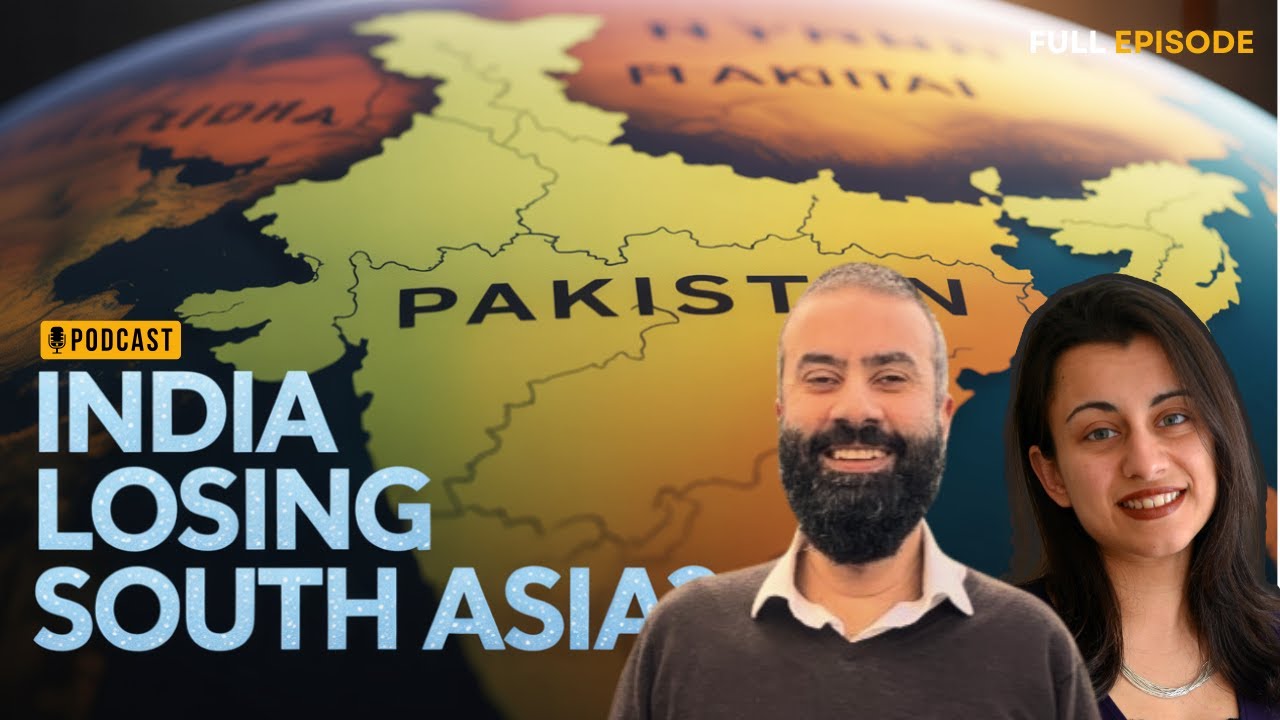
Dr. Mariam Mufti on the India-Pakistan Conflict, China’s Role & the Balochistan Crisis
Why did the May 2025 India-Pakistan conflict escalate so differently from every prior confrontation between the two countries? And what does China’s unprecedented public backing of Pakistan signal for the future of South Asia?
In this episode of the Kianistan Podcast, host Tafhim Kiani sits down with Dr. Mariam Mufti, Associate Professor of Political Science at the University of Waterloo, to unpack the conflict, its fallout, and the long-running crisis in Balochistan.
Drawing on her research into Pakistan’s political instability and civil-military relations, Dr. Mufti walks through why this confrontation broke from decades of precedent — from India’s decision to suspend the Indus Waters Treaty to China’s unusually direct diplomatic backing of Pakistan.
The conversation also covers the roots of unrest in Balochistan, and how the wider realignment between Pakistan, China, Russia, and Iran is reshaping the region.
Key Topics Discussed
Why the Pahalgam Attack Escalated Differently Than Past Crises
Dr. Mufti explains what set this confrontation apart from earlier flashpoints along the Line of Control.
The discussion explores:
- Comparing the Pahalgam attack of 2025 to Uri in 2016 and Pulwama in 2019
- India blaming Pakistan for the attack without publicly producing evidence
- India’s unprecedented decision to suspend the Indus Waters Treaty
- India breaking from its own doctrine of restricting strikes to Kashmir alone
India’s Tactical Win, Strategic Loss
Dr. Mufti argues that India’s battlefield gains did not translate into a broader diplomatic victory.
Topics include:
- How India managed to penetrate Pakistani air defenses on the first day
- Why India found almost no international backing for its rhetoric
- The US reinserting itself into the Kashmir conversation, against India’s own preference
- Why the terrorism framing ultimately failed to gain international traction
Why the War Stayed Short
The conversation examines the forces that kept the confrontation from spiraling further.
- The role of mutually assured destruction and nuclear risk
- Pakistan’s ambiguous “full spectrum deterrence” doctrine
- How rapid US diplomatic back-channel activity helped cool tensions
- Domestic political pressures facing both General Asim Munir and Narendra Modi
China’s Unprecedented Role
Dr. Mufti highlights how China’s posture in this conflict broke sharply from its historical pattern.
- Why China broke from its usual calls for restraint on both sides
- Chinese technology, including the J-10C and PL-15 missile, tested in real combat for the first time
- How China used India’s distraction to deepen ties with Nepal, Bangladesh, and Sri Lanka
- Why China considers a weakened Pakistan unacceptable to its own strategic interests
Balochistan’s Long-Running Crisis
The discussion turns to the province’s deep and largely separate set of grievances.
- The roots of Baloch grievances in Pakistan’s federal structure
- Foreign and Chinese investment in Reko Diq and Gwadar without meaningful provincial buy-in
- Reports of Indian support for insurgent groups operating in Balochistan
- Why Pakistan’s military-first approach has deepened rather than resolved the instability
A Region Realigning
The episode closes by placing the conflict within a much larger regional realignment.
- Pakistan’s unprecedented public solidarity with Iran despite the Sunni-Shia divide
- Russia and China’s overlapping interests in a Pakistan-Iran corridor
- India’s strategic dilemma between its economic ties to Iran and its alignment with Israel and the US
Major Takeaways
- The May 2025 conflict broke from decades of precedent, including India’s suspension of the Indus Waters Treaty.
- India achieved a tactical battlefield edge but suffered a broader strategic and diplomatic setback.
- Nuclear risk and rapid US back-channel diplomacy helped keep the confrontation short.
- China’s direct, public backing of Pakistan during this conflict was unprecedented in scope.
- Balochistan’s instability stems from unresolved federalism issues, not simply external interference.
- A broader Pakistan-China-Russia-Iran alignment is visibly taking shape in the conflict’s aftermath.
About Dr. Mariam Mufti
Dr. Mariam Mufti is an Associate Professor of Political Science at the University of Waterloo, originally from Pakistan, with a PhD in Political Science from Johns Hopkins University. Her research focuses on why Pakistan remains an unstable democracy prone to military intervention, and on the country’s position within South Asian and international politics.
Her work focuses on:
- Comparative Politics
- Democratic Instability in Pakistan
- Civil-Military Relations
- South Asian International Politics
About Kianistan Podcast
Hosted by Tafhim Kiani, the Kianistan Podcast features conversations with leading academics, diplomats, and analysts on the conflicts and power struggles shaping South Asia and the wider world. This episode brings an academic, comparative-politics lens to the India-Pakistan conflict and Pakistan’s internal fault lines.
Topics regularly include:
- Pakistan
- India
- China
- Iran
- Balochistan
- South Asia
- International Relations
- World Politics
Frequently Asked Questions
Who is Mariam Mufti?
Mariam Mufti is an Associate Professor of Political Science at the University of Waterloo, originally from Pakistan, whose research focuses on democratic instability and military intervention in Pakistani politics.
Why did the 2025 India-Pakistan conflict escalate further than previous crises?
India broke from precedent by suspending the Indus Waters Treaty, blaming Pakistan without public evidence, and striking Pakistan’s heartland in Punjab rather than confining strikes to Kashmir, escalating the confrontation faster and further than the 2016 or 2019 crises.
What role did China play in the conflict?
China broke from its historic pattern of calling for restraint on both sides and instead publicly backed Pakistan’s sovereignty, while Chinese-supplied technology including the J-10C fighter and PL-15 missile was tested in real combat.
What is the root cause of the Balochistan crisis?
According to Dr. Mufti, the Balochistan crisis is fundamentally a problem of federalism gone wrong in Pakistan, driven by a lack of provincial autonomy and inadequate benefit-sharing from resource projects like Reko Diq and Gwadar Port.
Conclusion
Dr. Mariam Mufti’s analysis makes clear that the May 2025 India-Pakistan conflict was never just a bilateral military confrontation — it was a moment that exposed shifting international alignments, unresolved internal fault lines within Pakistan, and the growing weight of China’s presence in South Asia.
From the Indus Waters Treaty to Balochistan to Pakistan’s newfound solidarity with Iran, this conversation offers a comprehensive academic perspective on a region in the middle of a significant realignment.
Whether you’re interested in South Asian politics, China’s regional strategy, or the future of India-Pakistan relations, this episode is essential listening.
SEO Keywords
- Mariam Mufti
- India Pakistan Conflict 2025
- Pahalgam Attack
- Balochistan
- China Pakistan Relations
- Indus Waters Treaty
- South Asia Security
- Pakistan Iran Relations