
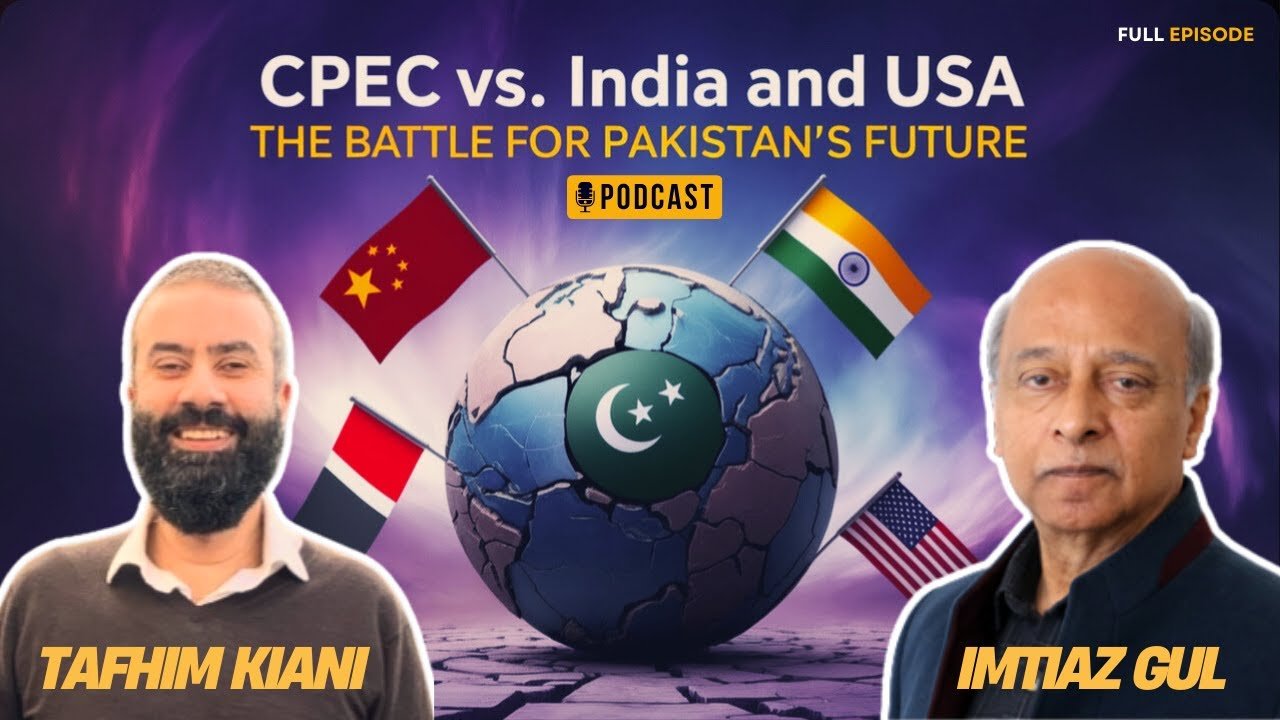
Baluch Separatism, CPEC, and India’s Covert War Against Pakistan – with Imtiaz Gul
In this powerful episode of Kianistan, host Kiani sits down with Imtiaz Gul, veteran journalist and Executive Director of the Center for Research and Security Studies, to unravel one of South Asia’s most complex and enduring crises — the Baluch separatist movement, India’s covert interference, and the China–Pakistan Economic Corridor (CPEC).
This episode dives deep into the intersections of geopolitics, insurgency, and regional rivalry, exposing the layers that define Pakistan’s struggle for stability.
The Train Hijacking in Baluchistan: A Symbol of Unrest
The episode opens with the shocking story of the train hijacking in Baluchistan, where hundreds of passengers were taken hostage. Gul recounts the rescue operation that lasted over 36 hours, underscoring the severe security challenges facing the region.
This incident reflects the larger insurgency problem, where militant groups like the Baluch Liberation Army (BLA) continue to challenge state authority under the banner of independence and grievance.
Understanding Baluch Separatist Movements
Imtiaz Gul outlines the five major separatist groups active in Baluchistan, including the BLA, BRP, and BLF — all united under the goal of an “independent Baluchistan.”
He traces the origins of the conflict to historical neglect, tribal grievances, and federal mismanagement.
The killing of Nawab Akbar Bugti in 2006 under General Musharraf’s regime, according to Gul, marked a major escalation. Political reconciliation efforts since then — including those led by Dr. Abdul Malik Baloch — failed to gain traction, largely because security policy remains in the hands of Pakistan’s military establishment rather than civilian governments.
India’s Role: The Ajit Doval Doctrine
Gul reveals the strategic thinking behind India’s covert involvement in Baluchistan — tracing it back to the Ajit Doval Doctrine.
Formulated around 2009 and implemented after Narendra Modi’s rise to power, this policy advocates “exploiting Pakistan’s internal fault lines” as retaliation for Pakistan’s Kashmir stance.
From India granting asylum to Baluch separatist leaders like Brahamdagh Bugti to Modi’s 2016 Independence Day speech mentioning Baluchistan, Gul argues that India’s objective has been to destabilize Pakistan and disrupt CPEC, aligning with U.S. interests in containing China.
The Afghanistan–Iran Nexus and Cross-Border Militancy
The conversation turns toward Afghanistan and Iran’s roles in the wider instability.
Gul notes that despite shared security threats, cross-border militant movements such as Jundullah and Jaish al-Adl complicate relations.
While both Iran and Pakistan have coordinated to control militant activity along their 900-km border, geography and proxy influences make total control difficult.
However, Gul emphasizes that both nations have improved cooperation through intelligence sharing and joint operations in recent years.
CPEC and the Great Game: China’s Investment in Pakistan
No discussion about Baluchistan is complete without CPEC (China–Pakistan Economic Corridor).
Gul examines the project as a transformative economic vision for Pakistan — but one that has been hindered by poor governance, security threats, and political inefficiency.
He highlights how bureaucratic incompetence, COVID-19 delays, and imbalanced project distribution favoring Punjab alienated smaller provinces like Baluchistan.
China’s initial state-led investment has now shifted to business-to-business projects, awaiting Pakistan’s political stabilization.
The U.S. Factor and Pakistan’s Strategic Drift
Gul also discusses how under General Bajwa, Pakistan’s establishment began pivoting back toward the U.S., creating friction with Beijing.
He argues that this strategic ambiguity — balancing between Washington and Beijing — weakened Pakistan’s economic and diplomatic position.
The U.S., meanwhile, sees CPEC as part of China’s growing influence, while China views Pakistan as a strategic gateway to the Indian Ocean.
According to Gul, this tug-of-war leaves Pakistan economically vulnerable and politically unstable.
Can CPEC Still Succeed?
Despite all challenges, Imtiaz Gul believes that China will not disengage from Pakistan.
CPEC, he emphasizes, is not just a project — it’s an idea of economic cooperation and regional integration.
While mismanagement and corruption have slowed progress, China’s long-term strategic interest ensures continued engagement.
However, for CPEC to truly succeed, Pakistan must modernize governance, resolve internal unrest, and build trust across its provinces.
Conclusion: A Nation at Crossroads
This episode of Kianistan paints a sobering picture:
Baluchistan’s unrest is more than a local rebellion — it’s a geopolitical chessboard where India, the U.S., China, Iran, and Afghanistan all play parts.
Pakistan’s future stability depends on its ability to:
-
Bridge internal divides
-
Assert civilian control over regional policy
-
And transform CPEC from a political slogan into a national development engine
Imtiaz Gul leaves listeners with a clear message — without political reform and unified purpose, economic opportunity will remain hostage to instability.
Watch on YouTube
🎥 Watch the full conversation with Imtiaz Gul on Kianistan’s official YouTube channel:
SEO Keywords
Baluch separatism, CPEC Pakistan, Indian covert war, Ajit Doval Doctrine, Imtiaz Gul interview, Kianistan podcast, China Pakistan relations, Gwadar Port, Baluchistan insurgency, Pakistan Iran border, Pakistan Afghanistan relations, U.S. China rivalry in Pakistan, Pakistani military and CPEC, Baluchistan instability, terrorism in Pakistan, Indian RAW in Baluchistan, economic corridor Pakistan, geopolitical analysis podcast