
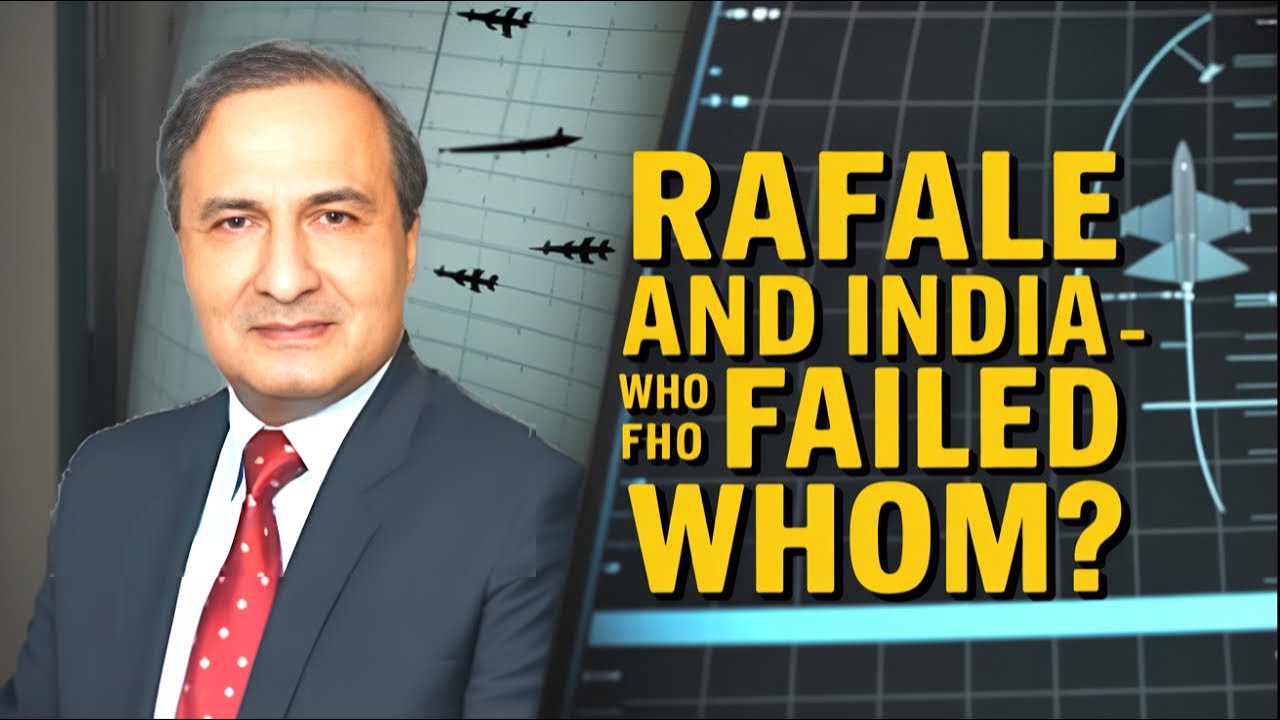
How Pakistan Air Force Downed 3 Rafales in 1 Hour: Air Commodore Khalid Chishty Explains India-Pakistan Air War
How did a numerically outmatched air force manage to shoot down three French-built Rafale jets in a single hour? And what does the May 2025 air war between India and Pakistan really reveal about the future of aerial combat?
In this episode of the Kianistan Podcast, host Tafhim Kiani sits down with Air Commodore (Retd) Khalid Chishty, a 35-year veteran of the Pakistan Air Force, to unpack the air battle that took place between India and Pakistan in May 2025.
Drawing on decades of frontline flying, staff command, and teaching at Pakistan’s premier war colleges, Air Commodore Chishty walks through exactly how the engagement unfolded — from the first night of beyond-visual-range strikes to Pakistan’s calculated decision not to escalate further than it had to.
The conversation covers the Rafale’s combat record, the role of the J-10C and PL-15 missile, how Pakistan’s air defenses tracked and disabled Indian S-400 batteries, and why nuclear risk loomed over the entire exchange.
Key Topics Discussed
Why Pakistan Air Force Went on the Offensive
Air Commodore Chishty explains why Pakistan broke from decades of defensive doctrine and chose to fight offensively from the very first night.
The discussion explores:
- Why Pakistan Air Force anticipated an offensive posture days before the escalation began
- How India misjudged Pakistan’s likely response
- Why air power is inherently an offensive tool, not a defensive one
- The five inherent advantages air power holds over land and naval forces
The Night of 7 May: How the Air Battle Unfolded
The conversation reconstructs the sequence of events after India struck nine sites inside Pakistan, including civilian areas.
Topics include:
- How Pakistan Air Force converted a defensive mission into an offensive one mid-flight
- Why six-plus Indian aircraft were shot down in a single beyond-visual-range engagement
- Pakistan’s deliberate strategy of “war deterrence” rather than full-scale escalation
- The massive retaliatory strike launched on the morning of 10 May
Rafale vs J-10C: Why the Aircraft Wasn’t the Real Story
Air Commodore Chishty gives a detailed history of the Rafale’s combat record and explains why the outcome had little to do with the airframe itself.
- The Rafale’s 24-year service history and prior combat losses
- Why three Rafales lost in one hour breaks a two-decade safety record
- Why “it’s not the weapon system, it’s the employment” that decided the battle
- How Pakistani pilots trained directly alongside Chinese counterparts on the J-10C
Multi-Domain Warfare and the “Kill Picture”
A central theme of the conversation is how modern air combat has moved far beyond the dogfights of previous generations.
The discussion covers:
- How jammers, airborne early warning, cyber command, and satellites work as one integrated system
- Why Pakistan’s networked “kill picture” outperformed India’s larger but less-integrated force
- What happens if the technology or network fails mid-combat
- Why Pakistan builds its systems domestically rather than relying on foreign networks
Targeting the S-400 Air Defense System
One of the most striking claims in the interview concerns Pakistan’s targeting of India’s Russian-made S-400 batteries.
- Why the S-400 had never before been targeted by any air force in the world
- How Pakistan located and struck the system’s radar and command elements
- Why full details of the tactics used remain undisclosed for now
Nuclear Risk in a Conventional Air War
With both nations nuclear-armed, the conversation turns to how close the conflict came to a far more dangerous escalation.
Key points include:
- The hundreds of civilian airliners flying through the contested airspace during the clashes
- How Pakistan diverted or disabled an incoming BrahMos missile
- Why misdirected conventional missiles could have drawn in third countries like Iran or Afghanistan
- Why Pakistan’s response demonstrated it would not be constrained purely by nuclear deterrence rhetoric
Budgets, Bureaucracy, and the India-Pakistan Capability Gap
Air Commodore Chishty explains how Pakistan has historically matched a far better-funded adversary.
- Why Pakistan Air Force operates on a fraction of India’s defense budget
- How faith in the cause, training quality, and timely technology induction close the numerical gap
- Comparing Pakistan’s JF-17 Thunder program to India’s long-delayed Tejas fighter
- Public comments from India’s own Air Chief Marshal about repeated procurement delays
Major Takeaways
- Pakistan Air Force shifted from decades of defensive doctrine to a deliberately offensive response.
- The Rafale’s combat loss was a function of employment and integration, not the aircraft itself.
- Pakistan’s networked, multi-domain “kill picture” was decisive against a larger but less-integrated Indian force.
- India’s S-400 air defense system was targeted in combat for the first time anywhere in the world.
- Civilian air traffic and a diverted BrahMos missile underscored the nuclear-adjacent risks of the conflict.
- Training quality and timely technology induction have historically let Pakistan offset India’s much larger defense budget.
About Air Commodore (Retd) Khalid Chishty
Khalid Chishty served in the Pakistan Air Force for 35 years, flying the F-6 and French Mirage aircraft across roughly 3,000 flying hours. He held staff and command appointments including Base Commander at Karachi, and taught at the Pakistan Naval War College, Pakistan Air Force War College, and the National Defense University.
Since retiring in 2012, he has settled in Lahore, where he runs his own business, teaches at LUMS, and produces documentaries on the Pakistan Air Force and on the life of Muhammad Ali Jinnah, Pakistan’s founding father.
His work focuses on:
- Air Power and Military Strategy
- South Asian Security
- Pakistan Air Force History
- Documentary Filmmaking
About Kianistan Podcast
Hosted by Tafhim Kiani, the Kianistan Podcast features conversations with leading military professionals, academics, and geopolitical analysts on the events reshaping South Asia and the wider world. This episode brings a rare insider’s perspective from a career Pakistan Air Force officer on the most significant India-Pakistan air battle in decades.
Topics regularly include:
- Pakistan Air Force
- India-Pakistan Relations
- Military Strategy
- South Asia
- China
- Defense Technology
- Nuclear Deterrence
- World Politics
Frequently Asked Questions
Who is Khalid Chishty?
Khalid Chishty is a retired Air Commodore who served in the Pakistan Air Force for 35 years, including as Base Commander at Karachi, and later taught at Pakistan’s leading war colleges before turning to documentary filmmaking.
Did Pakistan Air Force really shoot down three Rafale jets in one hour?
According to Air Commodore Chishty, Pakistan Air Force shot down six-plus Indian aircraft, including three Rafales, during a beyond-visual-range engagement on the night of 7 May 2025 — a record loss for an aircraft that had never previously been shot down in nearly 24 years of service.
What is multi-domain warfare?
Multi-domain warfare refers to the integrated use of fighter aircraft, jammers, airborne early warning systems, surface-to-air missiles, satellites, and cyber capabilities as a single networked system, rather than relying on individual aircraft fighting in isolation.
Was the S-400 air defense system really targeted in this conflict?
Air Commodore Chishty states that Pakistan targeted Indian S-400 batteries during the conflict, marking the first time this Russian-made air defense system has been targeted in combat by any air force.
Conclusion
The May 2025 air battle between India and Pakistan offered the clearest picture yet of what 21st-century aerial warfare actually looks like — not dogfights, but networked, multi-domain engagements decided by integration, training, and doctrine as much as by the aircraft themselves.
Air Commodore Khalid Chishty’s firsthand perspective, shaped by 35 years in uniform and years of post-conflict analysis, offers a rare, detailed account of how Pakistan Air Force met a numerically and financially superior adversary — and why the outcome surprised much of the world.
Whether you’re interested in military strategy, South Asian security, or the future of air combat, this episode is essential listening.
SEO Keywords
- Khalid Chishty
- Pakistan Air Force
- Rafale Shot Down
- India Pakistan Air War
- J-10C
- PL-15 Missile
- S-400 Air Defense
- India Pakistan Conflict 2025
- Multi-Domain Warfare