
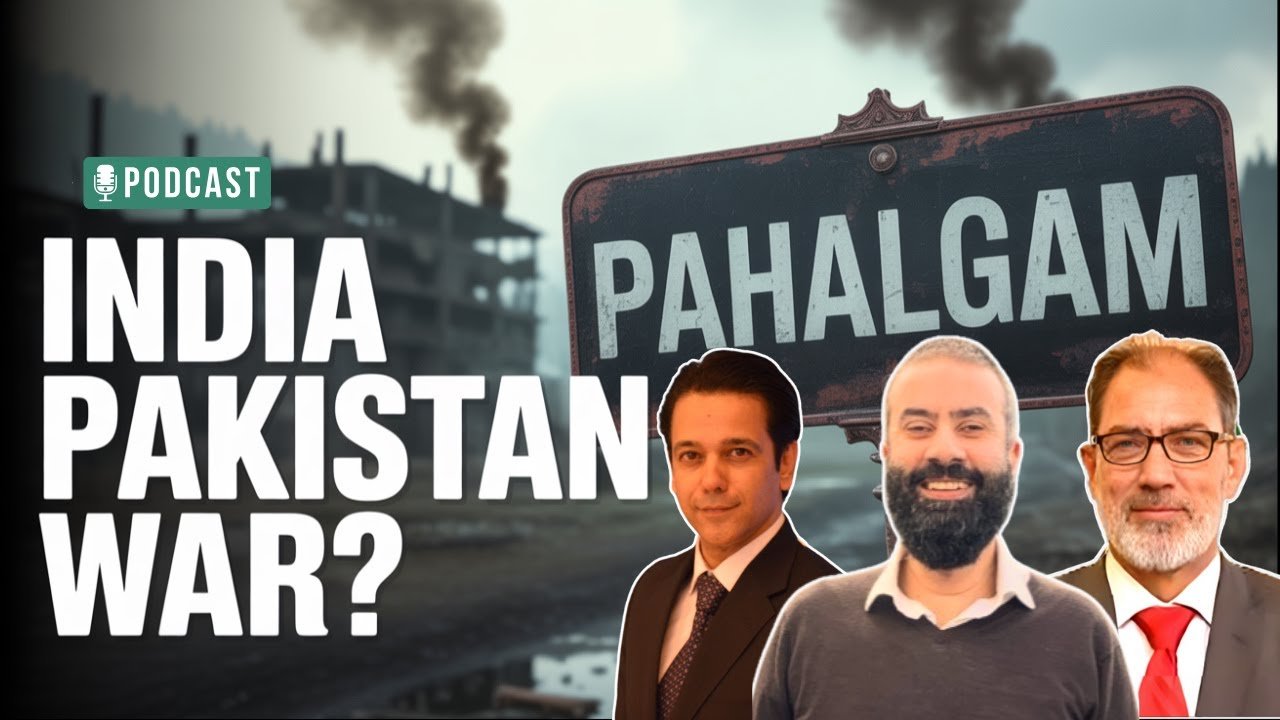
Could India and Pakistan Go to War Over Pahalgam?
A Geopolitical Discussion with Ahmed Quraishi and Altaf Wani
Tensions between India and Pakistan remain among the most dangerous in the world. Even decades after partition, incidents in Kashmir continue to carry the risk of rapid escalation between two nuclear-armed states. In this episode, journalists and analysts Ahmed Quraishi and Altaf Wani examine whether events such as the Pahalgam incident could realistically push South Asia toward another military confrontation
[English (auto-generated)] Epis…
.
This discussion explores the political, military, and media dynamics that shape India-Pakistan relations—and why miscalculation remains the greatest threat to regional stability.
Why Pahalgam Matters in India-Pakistan Relations
Pahalgam, a town in Indian-administered Kashmir, has symbolic and strategic importance. Any violent incident in the region immediately becomes:
-
A national security issue in India
-
A diplomatic flashpoint with Pakistan
-
A media-driven narrative battle
Ahmed Quraishi explains that Kashmir-related incidents are often politicized rapidly, leaving little space for investigation or de-escalation. Public pressure, amplified by television media and social networks, can force governments into hardened positions
[English (auto-generated)] Epis…
.
Kashmir: The Core of the Conflict
A Dispute That Never Healed
Altaf Wani emphasizes that Kashmir is not merely a territorial dispute—it is a political and human conflict left unresolved since 1947.
Key realities include:
-
Militarization of daily life
-
Cycles of unrest and repression
-
Absence of meaningful political dialogue
-
International disengagement
Without addressing Kashmir politically, each new incident risks becoming a trigger for military escalation rather than a catalyst for peace
[English (auto-generated)] Epis…
.
Can a Local Incident Trigger War?
Both guests agree that war is not inevitable, but escalation pathways exist.
How Escalation Happens
-
Immediate blame before evidence
-
Media-driven nationalist outrage
-
Political pressure on leadership
-
Military signaling across borders
Ahmed Quraishi notes that modern conflicts often escalate not by design, but through reaction chains, where leaders fear appearing weak more than they fear war itself
[English (auto-generated)] Epis…
.
Nuclear Deterrence: Stability or False Comfort?
India and Pakistan’s nuclear capabilities are often cited as a stabilizing force. However, the discussion challenges this assumption.
The Limits of Nuclear Deterrence
-
Nuclear weapons do not prevent limited conflicts
-
Conventional clashes can spiral rapidly
-
Command-and-control risks remain
-
Misinterpretation of military signals is common
Altaf Wani argues that nuclear deterrence raises the cost of war, but does not eliminate the risk—especially during politically charged crises in Kashmir
[English (auto-generated)] Epis…
.
Media’s Role in Fueling or Preventing Conflict
A major theme of the episode is the role of media narratives.
Problems in Mainstream Coverage
-
Simplistic “good vs bad” framing
-
Absence of Kashmiri voices
-
Sensationalist language
-
Pressure for immediate retaliation
Both guests stress that irresponsible media coverage can accelerate escalation, while careful journalism can help slow it down
[English (auto-generated)] Epis…
.
Regional and International Actors
Despite the global consequences of an India-Pakistan war, international mediation has weakened.
External Factors
-
US strategic tilt toward India
-
China’s regional interests
-
Limited UN engagement
-
Declining trust in multilateral institutions
The lack of credible neutral mediators increases the danger that crises will be managed solely through military signaling rather than diplomacy
[English (auto-generated)] Epis…
.
What Would De-Escalation Look Like?
According to the discussion, preventing war requires:
-
Crisis communication channels
-
Independent investigations
-
Media restraint
-
Political courage on both sides
Most importantly, Kashmir must be treated as a political issue, not just a security problem.
Why This Conversation Matters
This episode stands out because it avoids sensationalism and focuses on realistic risk assessment. Instead of predicting war, it examines how war becomes possible—and how it can still be avoided.
As Ahmed Quraishi notes, peace between India and Pakistan is not impossible, but it requires breaking cycles of fear, narrative warfare, and political opportunism
[English (auto-generated)] Epis…
.
Final Thoughts: War Is a Choice, Not a Destiny
The Pahalgam incident highlights a deeper truth about South Asia’s security dilemma: the danger lies less in single events and more in how leaders, media, and institutions respond to them.
Understanding these dynamics is essential for anyone concerned with:
-
South Asian geopolitics
-
Nuclear risk
-
Conflict prevention
-
Media responsibility
SEO Keywords Used
India Pakistan war, Pahalgam Kashmir, Kashmir conflict analysis, Ahmed Quraishi, Altaf Wani, South Asia geopolitics, nuclear deterrence India Pakistan, India Pakistan tensions, Kashmir crisis